
News
Jinan University Lecture Review | Strategic Management Mindset: The Communication-Perspective-Context (CPC) Framework and Case Illustration
暨南大学讲座回顾|策略管理思维:传播模式-决策视角-语境/场域(CPC)理论框架与案例阐析
July 22, 2026
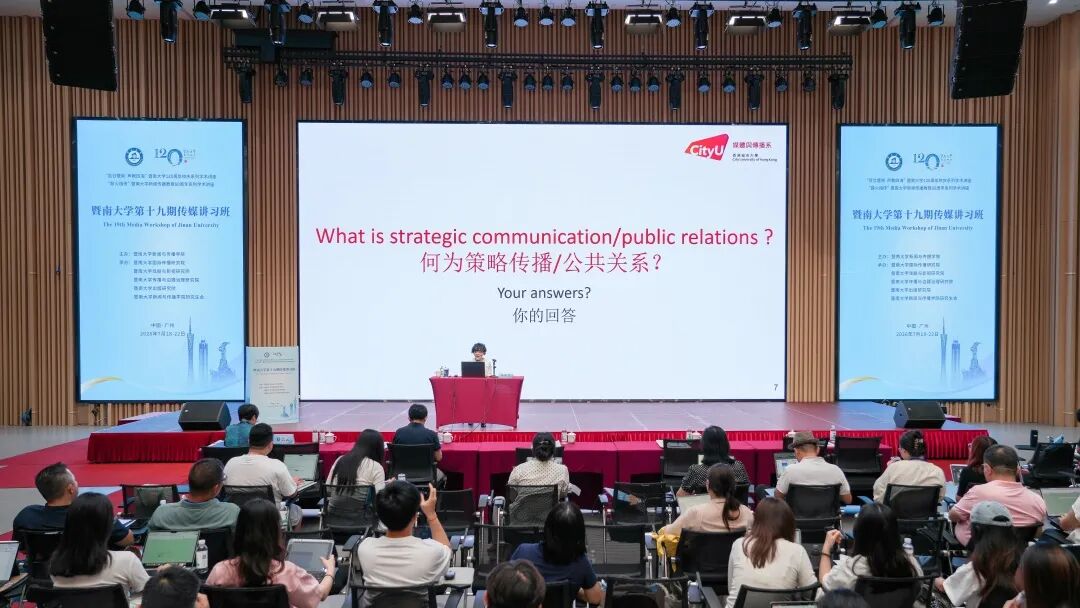
7月22日上午,香港城市大学媒体与传播系讲座教授黄懿慧应邀为暨南大学第十九期传媒讲习班带来题为《策略管理思维:传播模式-决策视角-语境/场域(CPC)理论框架与案例阐析》的专题讲座。本场讲座由暨南大学新闻与传播学院嵇美云副教授主持。
On the morning of July 22, Professor Yi-Hui Christine Huang of City University of Hong Kong was invited to deliver a lecture titled "Strategic Management Mindset: The Communication-Perspective-Context (CPC) Framework and Case Illustration" for the 19th Jinan University Media Training Program. The lecture was chaired by Associate Professor Ji Meiyun.
黄懿慧围绕策略传播与公共关系的基本概念展开分享。她指出,策略传播不仅是信息传递的过程,更是组织与公众之间的沟通与关系管理。在此基础上,她梳理了公共关系研究中的主要学派:语义修辞学派强调叙事与形象建构,整合营销学派关注品牌与市场传播,管理学派则重视组织与利益相关者之间的沟通、协调与信任建立。
Professor Huang shared the basic concepts of strategic communication and public relations, noting that strategic communication is not merely information transmission but also communication and relationship management between organizations and their publics. She then reviewed the major schools in public relations research: the rhetorical school emphasizing narrative and image building, the integrated marketing school focusing on brand and market communication, and the management school valuing communication, coordination, and trust building between organizations and stakeholders.
黄懿慧从传播模式、策略视角与传播语境/场域等方面进行分析。她表示,策略传播需要综合考虑传播方式、传播目标以及具体情境。其中,传播模式包括大众传播、中介传播与人际传播;策略视角需要判断信息传播是应该「作大」还是「作小」;传播语境/场域则强调时间、制度、文化环境以及媒介平台等因素对传播效果的影响。
Professor Huang then analyzed the communication mode, strategic perspective, and communication context. Strategic communication, she said, must consider the communication approach, objectives, and specific context. Communication modes include mass, mediated, and interpersonal communication; the strategic perspective requires judging whether to "amplify" or "narrow" the information; and the communication context emphasizes the influence of time, institutions, cultural environment, and media platforms on communication outcomes.
围绕CPC模型的应用,黄懿慧结合多个案例展开分析。针对西贝餐饮与胖东来相关事件,她进一步说明了「作大」与「作小」的策略差异:西贝事件中企业面对危机时采取了大量扩大议题的传播方式,与原本应降低冲突、修复关系的目标存在错配,导致舆论进一步扩散;而胖东来事件中,企业通过调查、公开回应、承担责任以及协调消费者与员工关系,实现了危机降温。
On the application of the CPC model, Professor Huang analyzed several cases. Comparing the Xibei and Pang Dong Lai incidents, she illustrated the strategic difference between "amplifying" and "narrowing": in the Xibei case, the company amplified issues during a crisis, mismatching its goal of reducing conflict and repairing relationships and further spreading public opinion; whereas Pang Dong Lai cooled the crisis through investigation, public response, accountability, and coordinating relations with consumers and employees.
讲座最后,黄懿慧分享了自己对于策略传播研究范式变化的思考。她指出,传播研究已经从早期关注信息传递、媒体曝光,逐渐转向声誉管理、关系管理,并进一步走向信任管理。
At the end, Professor Huang shared her reflections on the paradigm shift in strategic communication research, noting that communication research has moved from early attention to information transmission and media exposure, toward reputation management and relationship management, and further toward trust management.

本文转载并翻译自「暨南大学新闻与传播学院」微信公众号,原文链接:https://mp.weixin.qq.com/s/WxaZ-RWjBZgVhtRbd8wbMA
This article is reposted and translated from the WeChat official account of the School of Journalism and Communication, Jinan University. Original link: https://mp.weixin.qq.com/s/WxaZ-RWjBZgVhtRbd8wbMA